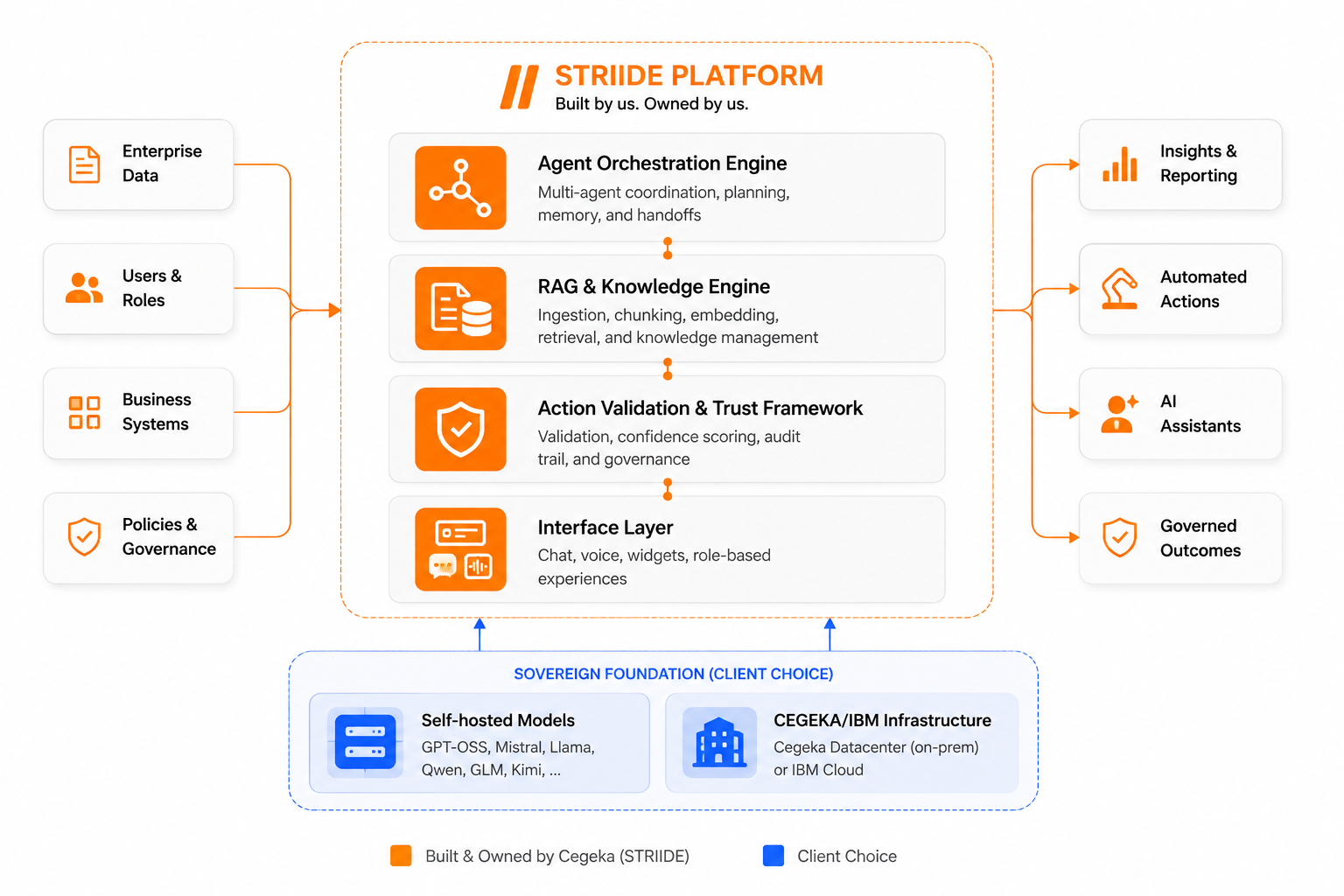
Choosing an AI platform is not just a technology decision — it's a trust decision. Who understands your processes, respects your data, and delivers results you can measure? Here's how two approaches compare.
At a Glance
A transparent look at where each platform stands today. We mark our own gaps honestly — we'd rather earn your trust than oversell.
Platform Approach
The fundamental difference comes down to ownership and independence. One platform is built to be yours. The other is built to keep you within a single vendor's ecosystem.
User Experience
STRIIDE is designed for both audiences: business users get an intuitive visual editor, while developers get full control over agent logic, code, and integrations — without sacrificing usability for either group.
Integrations & Extensibility
How each platform connects agents to external tools and services. Copilot Studio has breadth. STRIIDE bets on the emerging open standard.
Enterprise Security & Governance
Both platforms address enterprise security, but through fundamentally different models. STRIIDE offers physical data control through EU-owned infrastructure. Copilot Studio offers policy-based cloud governance within Microsoft's US-owned stack.
The Honest Take
The features above are comparable on many fronts. What actually decides the choice is not which platform has more checkboxes — it's who you trust with your AI strategy and your data.
Built and owned by Cegeka, a European company. Data is hosted in EU datacenters (Belgium, Netherlands) with no exposure to US legislation like the CLOUD Act.
Microsoft offers EU Data Boundary and Azure regions in Europe, but remains a US-headquartered company subject to US jurisdiction — a consideration for regulated European organizations.
Full white-label capability and native multi-tenant architecture. MSPs, system integrators, and partners can run isolated client environments under their own brand on a shared platform.
Always Microsoft-branded. Per-environment isolation exists within a single M365 tenant, but there's no native multi-tenant model for partners to manage multiple clients from one platform.
The real value is not in the model — it's in how you orchestrate and apply it. STRIIDE lets you self-host LLMs on Cegeka/IBM datacenters or your own infrastructure, with full control over which models run, where they run, and how they're configured.
Access to 1,800+ models through Azure AI Foundry, but all hosted within Azure. No option to run models on your own infrastructure outside the Microsoft cloud.
MCP-native from day one with a curated library of 100+ pre-configured servers — browse, select, and connect without manual setup. The open standard means integrations are portable across LLMs and infrastructure providers.
MCP support is now generally available with a connect-your-own model: point to any MCP server URL or build a custom connector through Power Platform. A certification program and growing marketplace exist, but no pre-configured MCP library ships out of the box.
Connects to Microsoft services through MCP servers (Azure DevOps, SharePoint via MCP). Integration is possible but not as deeply embedded as a native Microsoft product.
Native integration with Teams, SharePoint, Dynamics 365, Outlook, and the full Power Platform. If your organization is standardized on Microsoft, this is a natural fit.
Cegeka provides direct, hands-on implementation — from consultancy-led builds to self-service. You work with the team that built the platform, not a reseller layer.
Implementation support comes through Microsoft's global partner network. Quality and depth vary by partner. Direct Microsoft engagement typically requires Enterprise agreements.
Three entry models matched to what you need: a consultancy-led build, a plug-and-play shared tenant for smaller teams, or a dedicated instance for full ownership. The price is the price — no hidden dependencies on separate Microsoft 365, Power Platform, or Azure licenses. Implementation support is part of the offering, not an add-on.
Starts at $200/month for 25,000 messages, with pay-as-you-go and prepaid options. But the real total cost often includes Microsoft 365 licenses, Power Platform licensing, and Azure services depending on which features you use — these are separate costs that aren't always obvious upfront. Professional services come through partners, priced separately.